
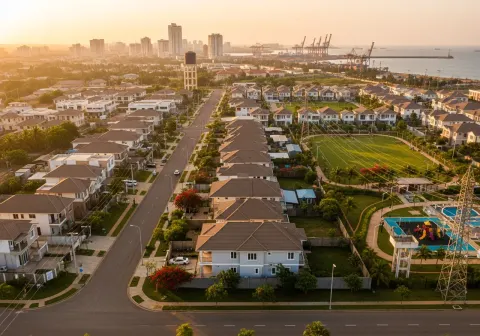
Why shifting from sending monthly remittances to investing in income-generating property builds generational wealth.
If you are a Ghanaian living in the United States, you are almost certainly sending money home. Ghana receives over $4 billion in remittances annually, and the average diaspora household sends a meaningful portion of its income — for many families, it is the financial backbone that supports aging parents, pays school fees, and covers household expenses. This generosity is profound and it is right. But it is worth asking an honest question: is the money working as hard as it could be?
The Mathematics of Remittances Over Time
Consider a household sending $500 a month to family in Ghana. Over ten years, that is $60,000 transferred — real money, real sacrifice. Every dollar of it met an immediate need. But at the end of ten years, the household has $60,000 in spent consumption and no asset to show for it. If the cedi depreciated against the dollar during that period — which it has consistently done over the past decade — the purchasing power of each monthly transfer also declined over time, meaning the family received less in real terms each year even as the dollar amount stayed the same.
What Property Ownership Changes
Property investment does not eliminate the responsibility to support family — for most diaspora households, that is simply not on the table. What it does is create a parallel track: a growing asset that over time can generate its own income and reduce or eliminate the need for ongoing transfers. A two-bedroom apartment in a well-chosen Accra neighborhood, purchased for $80,000 to
Remittances solve today's problem. Property solves tomorrow's problem and today's problem at the same time — if you buy the right property in the right place.
The Generational Wealth Argument
The most compelling case for property over remittances is not mathematical — it is generational. A piece of land with clear title, a home that belongs to the family, or an income-producing apartment is an asset that can be passed to your children and your children's children. Remittances create no such inheritance. The diaspora communities that have built lasting wealth are the ones that shifted, over time, from consumption support to asset accumulation. Property is the primary vehicle for that shift.
This Is Not an Either/Or Decision
We are not suggesting you cut off your family. We are suggesting a different framing: instead of asking 'how much should I send this month,' ask 'how do I redirect a portion of what I send into an asset that will eventually send money on my behalf?' For many diaspora households, this looks like a two to three year period of disciplined saving — sometimes with reduced but not eliminated transfers — followed by a property purchase that, once it generates rental income, restores and eventually exceeds what was being sent.
The Practical Path Forward
- Calculate your total remittances over the past five years. That number, for most households, is startling — and clarifying.
- Identify what portion of those transfers covered genuine emergencies versus recurring household expenses. Recurring expenses are the ones that can eventually be replaced by rental income.
- Set a target property budget. In Accra's mid-market, a rental-ready property requires $60,000 to 50,000. In Prampram or the growth corridors, your entry point can be lower.
- Open a dedicated savings account — separate from your US household budget — and begin building toward that target. Even $300 per month accumulates to
8,000 in five years.- Engage a broker who understands both the Ghana property market and the financial reality of diaspora households. The right professional will help you model the numbers honestly.
The diaspora community has already demonstrated extraordinary generosity. The next chapter is channeling that same commitment into assets that outlast the sender. You have the tools, the access, and the income to do this at a different scale. The question is whether you have the right plan.
Written by
Irene Owoo
Licensed realtor bridging Atlanta and Accra. Irene specializes in helping members of the African diaspora invest in real estate on both sides of the Atlantic.
About Irene - Open a dedicated savings account — separate from your US household budget — and begin building toward that target. Even $300 per month accumulates to